At Zugvögel Festival 2026, our floor became a church - and what is a church without a confessional? So I built one: a wooden confessional box where festival visitors confess their sins to an AI priest, who teases the juicy details out of them, grants absolution, and then sends them onwards to the Holy Toilet - where their sins, anonymized and retold in an angel’s voice, are played back to whoever is enthroned there at the moment.
[Read More]
Code to create a WLED LED-Map (the JSON that tells WLED the positions of the LEDs) with some features that I didn’t find in any online editors: Dragging the mouse over the canvas fills all hovered cells, rescaling the map to a different size, inverting, and inserting LEDs in between existing ones.
[Read More]
An interactive, networked spaceship you can actually board: players complete (or sabotage) missions across a dozen physical interfaces - buttons, joysticks, LED boards, sensors, etc - to either launch the ship or doom it, with everything driven by a Python/ESP/Unity stack. It’s modular, auto-resets regularly, and scales to festival crowds without manual babysitting.
[Read More]
During my discontinued PhD at DLR, I developed and trained a graph neural network to combine code embeddings into repository-level representations and align them with scientific publications. Preliminary evaluation showed a promising improvement over pooling baselines, as a first step towards finding related implementations and their underlying assumptions across research fields.
[Read More]
VisioLab is a startup that creates automated self-checkout registers for canteens, where the meals on the tray are recognized on on-device via an iPad, allowing the customer to pay for their meals within seconds without requiring an employee.
[Read More]
The Siddata project developed a digital study assistant that helps students find relevant courses, learning resources, and study partners using personalized recommendations. I developed machine learning recommenders and worked extensively on its Django backend, turning a research prototype that previously took days to deploy into a containerized, tested, and easily deployable system. My masters thesis was also conducted in the scope of this project.
[Read More]
For this thesis, I created a Conceptual Space from Course Descriptions for explainable Recommendation, in a highly performant pipeline on the university-grid.
Sub-Pages:
[Read More]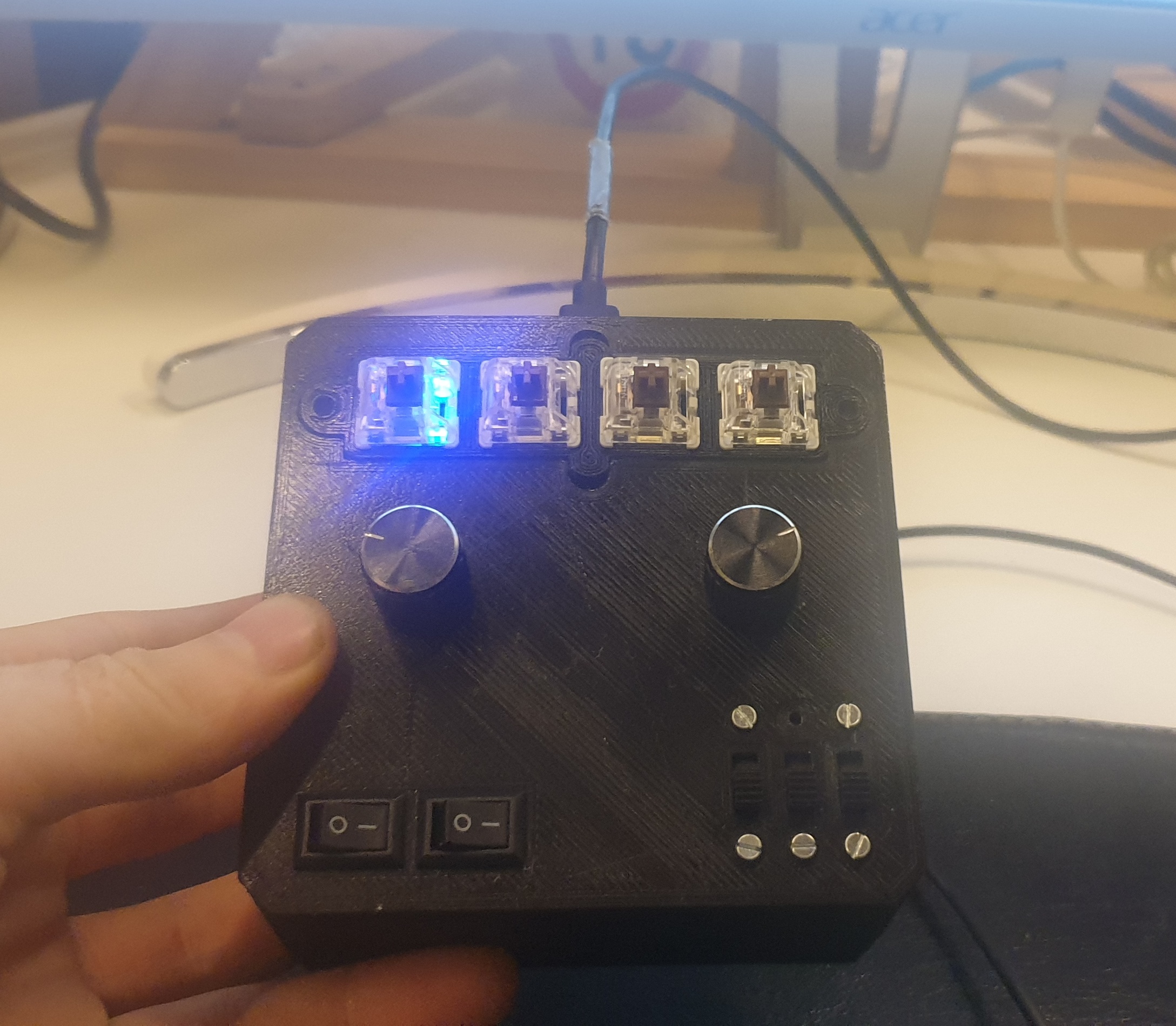
After finally (and only for now) accepting that a reliable sound2light-bassline-detection is probably more trouble than it’s worth, I next needed a way for tap2bpm instead. This, however, required new Hardware, and thus, I developed this Button-Board.
[Read More]


As a student research assistant at the Red Hen Lab, I worked on a video-processing pipeline for automatic gesture analysis in large video corpora. My work involved person tracking and identification using face recognition, shot segmentation, and deploying the pipeline on an HPC cluster using Snakemake and Singularity.
[Read More]
A comprehensive course, with lectures and interactive assignments, about Scientific Programming in Python, offered for three years at the University of Osnabrück.
[Read More]
A speech-controlled meditation assistant and sentiment tracker
[Read More]
An automated pipeline to split a bunch of scanned pages into single documents
[Read More]
Delving into the realm of self-driving cars for my bachelor’s thesis, I endeavored to optimize their tactical decisions, particularly speed, using cutting-edge deep neural networks and reinforcement learning in tensorflow within a transformed racing simulation. The resulting research platform, built on Unity, showcased the potential of real-time feedback and adaptability, offering valuable insights into the future integration of reinforcement learning in self-driving cars.
[Read More]